See the structure
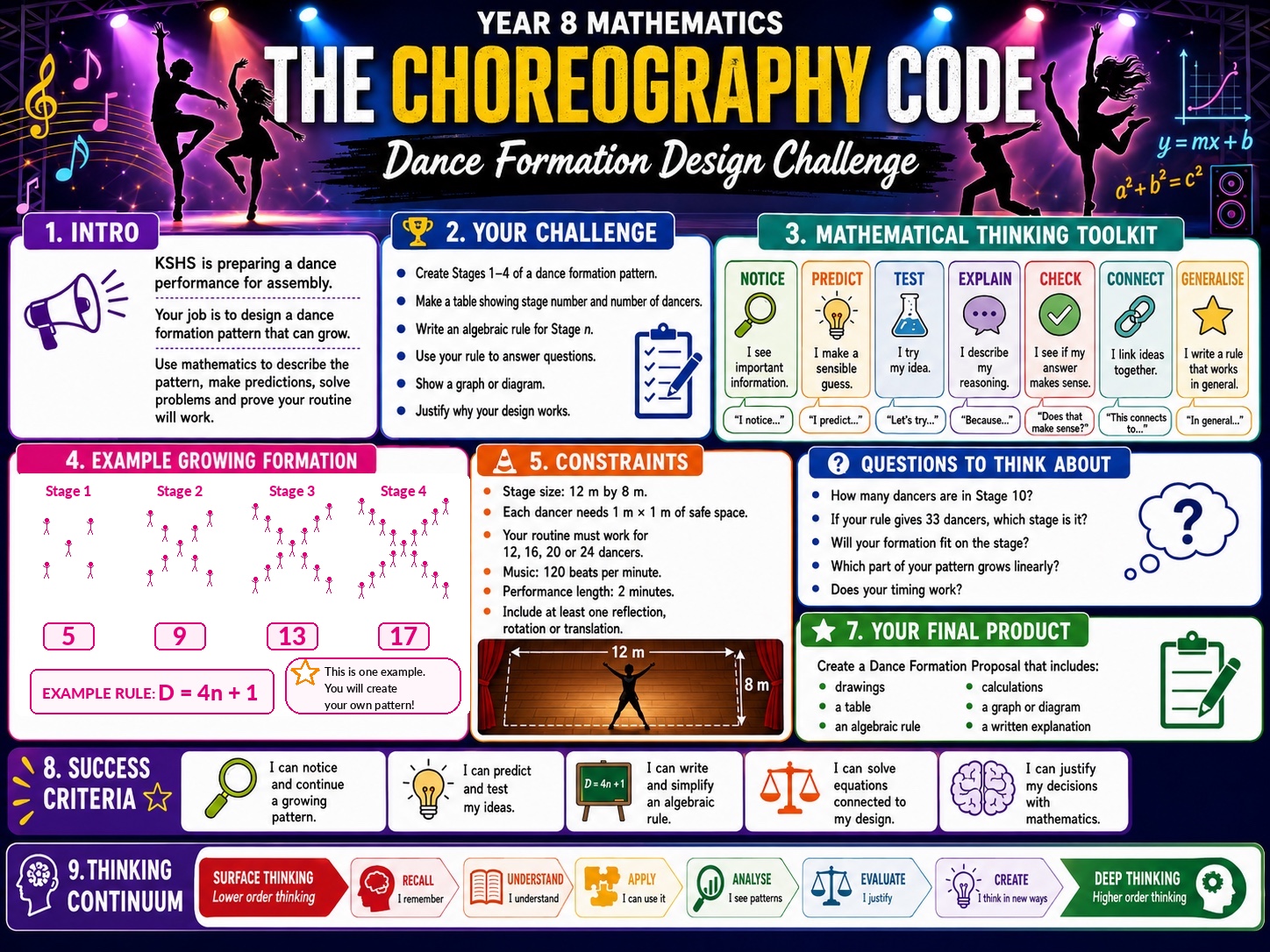
How can a growing formation become an algebraic rule?
Stages, tables, simplified expressions and tested rules.
A KSHS WSIM learning sequence in which students turn growing dance formations into algebra, graphs, equations, transformations, timing plans and a written mathematical proposal.
How can a growing formation become an algebraic rule?
Stages, tables, simplified expressions and tested rules.
What do gradient, intercept and transformations tell a choreographer?
Linear graphs, line comparisons and precise movement descriptions.
Will the dancer count, timing and stage dimensions all work together?
Equations, rates, Pythagoras and an audited prototype.
Can a proposal be justified with connected mathematical evidence?
A written formation proposal, corrections and transfer.
Developed individually across Lessons 13–15; submitted in Lesson 15 · 40 marks
The unit uses the revised SCSA Western Australian Curriculum: Mathematics for implementation in 2026. It is mapped by strand, sub-strand and content description rather than legacy ACMNA/ACMSP codes.
The image’s rule D = 4n + 1 is used as a launch. The assessed Year 8 demand comes from simplifying and factorising expressions, connecting y = mx + c to a graph, comparing lines, solving equations, using rates and testing spatial constraints.
Ready, Set, OLNA © Mathematical Association of Western Australia 2025. The four Numeracy Interleaved Practice sets use new Choreography Code contexts and values informed by the support-lesson structures in the supplied resource. This attribution appears for teachers; student lesson titles do not use the resource name.